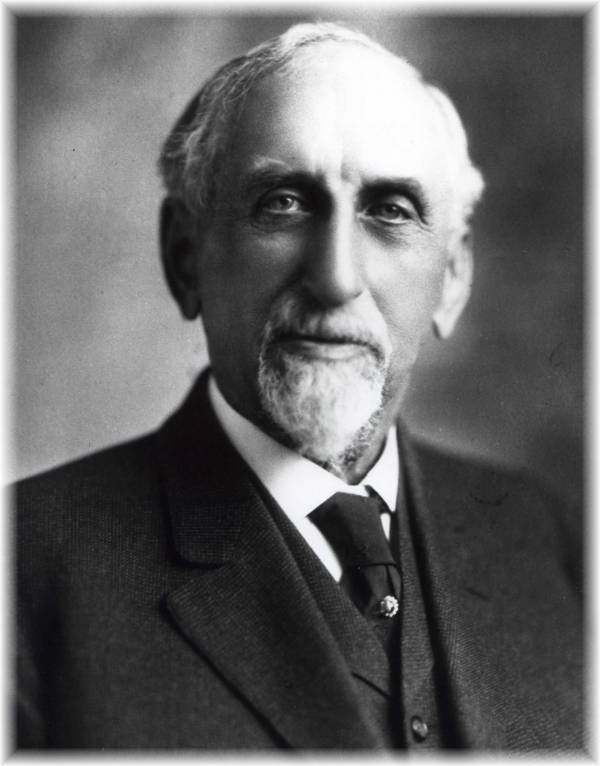
 Daniel Chase Corbin was born in Newport, New Hampshire. In
1860 he married Louisa Jackson; they had three children - Austin, Louise, and
Mary. Mr. Corbin was actively involved in the growth and settlement of the
West by doing everything from survey work and land transactions in Nebraska, government freighting
in Utah and Colorado, to banking in Montana. All of this he did before
settling in Spokane, where he quickly became a financial success.
Daniel Chase Corbin was born in Newport, New Hampshire. In
1860 he married Louisa Jackson; they had three children - Austin, Louise, and
Mary. Mr. Corbin was actively involved in the growth and settlement of the
West by doing everything from survey work and land transactions in Nebraska, government freighting
in Utah and Colorado, to banking in Montana. All of this he did before
settling in Spokane, where he quickly became a financial success.
In 1886 after the discovery of the
Bunker Hill and Sullivan mines in the
Coeur d'Alene Mountains of Northern Idaho, Corbin helped erect the first concentrator at
the mine sites. Corbin then built the Spokane Falls & Idaho Railroad and the
Coeur d'Alene Railway & Navigation Company, which connected the "jump
off" point of Spokane with those lead and silver mining districts. Corbin's railroads were pivotal
in establishing Spokane's position as a railroad center in the Inland
Northwest. In 1888 he sold the line to Northern Pacific. Daniel
Corbin continued his entrepreneurship with the 1899 development of the Spokane
Valley Land and Water Company, bringing the Spokane Valley its first irrigation
project.
Mr. Corbin's first wife, Louisa, and their three children never
lived in the house now known as the D.C. Corbin House. Unhappy with life
in Spokane, Louisa moved with their children to Europe. Daughter Louise
became the wife of the Duke of Oxford in England. Austin returned to
Spokane as a young adult and worked with his father. Daughter Mary, after
a brief marriage to Kirtland K. Cutter, married an English nobleman, Edward
Balguy of London. Louisa died in Paris in 1900. Mary was later
divorced and moved to California where she died in the late 1930's.
For Mr. Corbin's important role in developing Spokane, the
Spokane Chamber of Commerce elected him its first honorary member in 1915.
D.C. Corbin died in 1918 and bequeathed the house to his second wife, Anna
L. Corbin, a colorful character in her own right.